
Trade union workplace access: Is your organisation ready?
Inna Ratsebarska, Employment Law & HR
Employers could soon face statutory requests from trade unions seeking access to their workplaces.
While many organisations already have constructive relationships with trade unions, the Employment Rights Act will introduce a formal process that HR teams will need to understand and respond to within relatively short timescales.
Inna Ratsebarska explains how the proposed regime will work, the key deadlines employers need to know, and the practical steps organisations can take now to prepare.
What is changing?
Currently, legislation in Great Britain does not provide trade unions with a general right of access to workplaces. Trade unions can generally only exercise their functions through individual union members within the workplace or through access arrangements agreed with an employer.
This position is set to change.
How will the new process work?
The proposed statutory framework establishes a structured process through which trade unions may seek workplace access.
Step 1: Trade union access request
The process begins when a trade union submits an "access request" to an employer, inviting the employer to enter into an "access agreement".
Secondary legislation is expected to prescribe the information that unions must include in a request, including:
- the purpose of the request
- a general description of the workers they wish to access
- whether physical access, digital access or both are sought
- the type of access requested, such as in-person meetings or access to digital worker forums
The draft Code of Practice encourages unions to provide as much information as possible at the outset to help negotiations progress constructively. It also suggests that a single access request may cover multiple premises operated by the same employer.
Step 2: Employer response
Once an access request has been received, employers will have 15 working days to issue a formal response notice.
This relatively short timeframe means organisations will need clear internal processes to assess requests.
Step 3: Negotiation
If the employer agrees to engage, both parties enter a 25-working-day negotiation period to agree the terms of workplace access.
If agreement is reached, those terms must be recorded in writing and jointly notified to the Central Arbitration Committee (CAC).
In practice, HR teams may need to coordinate this process, working alongside senior management, operational teams and legal advisers to ensure any arrangements are practical, proportionate and minimise disruption to the business.
What happens if agreement cannot be reached?
If an employer fails to respond within the 15-working-day response period, the trade union may apply directly to the CAC.
Similarly, if negotiations do not result in an agreement, either party can ask the CAC to determine whether workplace access should be granted and, if so, on what terms.
The CAC will also deal with complaints relating to alleged breaches of access agreements. Any appeal on a point of law from a CAC decision will lie to the Employment Appeal Tribunal (EAT).
Are there any exceptions?
Yes.
The CAC will not be able to order workplace access where an employer has fewer than 21 workers. While trade unions may still approach smaller employers to discuss voluntary arrangements, those organisations will not be required to participate in the statutory scheme.
The draft Code of Practice also makes clear that where employers and trade unions already have voluntary access arrangements in place, they should generally continue using those arrangements rather than seeking to formalise them through the new statutory process.
What are the risks of getting it wrong?
The consequences of failing to comply with an access agreement could be significant.
The CAC will have the power to issue financial penalties of:
- up to £75,000 for a first breach
- up to £150,000 for a second breach
- up to £500,000 for a third breach and subsequent non-compliance under the same access agreement
Given the potential level of fines, employers should ensure that any negotiated arrangements are realistic, practical and capable of being implemented consistently.
What should People Teams be doing now?
Organisations should start preparing now.
HR Teams should consider:
- What reasonable access arrangements might look like within their organisation
- Which areas of the business could be affected by physical or digital access
- How access could be facilitated while minimising operational disruption
- Which individuals should be responsible for responding to access requests
It will also be important to ensure that any future access agreements contain clear dispute resolution provisions, helping issues to be resolved at an early stage and reducing the risk of escalation.
Looking ahead
The new right of access is expected to come into effect in October 2026, but employers should use the time available now to review their current arrangements and prepare for the introduction of the new regime.
Early planning will help organisations respond confidently to access requests, comply with the new requirements and maintain constructive relationships with trade unions.
If you would like advice on how these proposals could affect your organisation or support in preparing for the new regime, please get in touch with Hay & Kilner's Employment Law & HR Team.
Expert commentary & updates

New duty to inform workers of their right to join a trade union is DELAYED!
The new duty to inform workers of their right to join a trade union has been delayed until January 2027. Here's what employers need to know next.
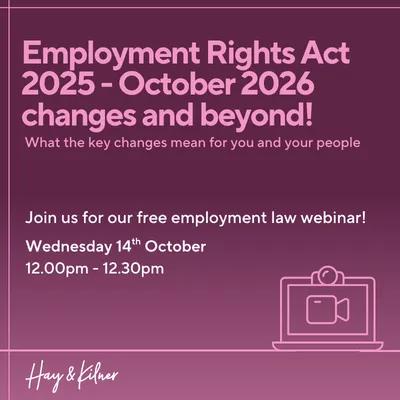
Employment webinar: 14th October 2026
Join Hay & Kilner’s Employment Team virtually on 14th October 2026 for an informative webinar on updates to the Employment Rights Act.

Ready or not: Why employers must act now on the Employment Rights Act
Employment Rights Act changes explained: Inna Ratsebarska, from our Employment Law & HR Team Team, outlines key reforms and why UK employers must act now to manage risk and prepare for 2027.

Preparing for the Employment Rights Act: What employers need to do now
Sarah Furness, from our Employment Law & HR Team, outlines how employers can prepare for the Employment Rights Act, including recruitment, zero-hours contracts, sickness absence and workplace culture changes.

The Employment Rights Bill: What’s planned and how can employers prepare
Sarah Furness, from our Employment Law & HR Team, explains the key proposals in the UK Employment Rights Bill and what employers can do to prepare for upcoming changes.
Unfair dismissal: Recent cases and what they tell us
Sarah Furness from our Employment Law & HR Team, explains what two recent Tribunals mean for what does and does not amount to a potentially unfair dismissal.

A personal approach to employment law
Discover how Hay & Kilner’s Employment Law Team delivers pragmatic, tailored legal and HR advice to employers, helping businesses navigate evolving workplace issues with confidence.
Leave us a message
Send us your query and we will be back in touch as soon as possible.
For the latest insights, updates and events join our mailing list